
Take those procedures off the shelf.
In most firms, the procedures live on a dusty shelf — maintained and read by different groups than those responsible for following them. Adversarial ships industry-leading expert procedures (RAMP for risks, CIRP for incidents) and applies them in real time via AI. The gap between written policy and program operation disappears.
Policy templates are too generic, but manual authoring is brutally inefficient.
Compliance platforms feed you one-size-fits-all policy templates — aspirational at best, hiding unrealistic promises under reams of fluff. RAMP and CIRP are the procedures that score your risks and grade your incidents; your Corporate Information Security Policy (CISP) is the other half — the body of policy the program holds everyone to, from shadow IT and removable media to BYOD, network access, and AI acceptable use. Ours are authored by veteran CISOs, not generated from a framework checklist.
And they're battle-tested around the clock: as Adversarial parses every risk and incident through the day, it applies your policy to real incident data — surfacing holes you didn't know were there and where a stance is aspirational or unrealistic. As the environment shifts, we centrally enhance the core policies, so you inherit new content when major changes demand it. That's Policy as a Service: centralized best practice, tuned to your threat profile.
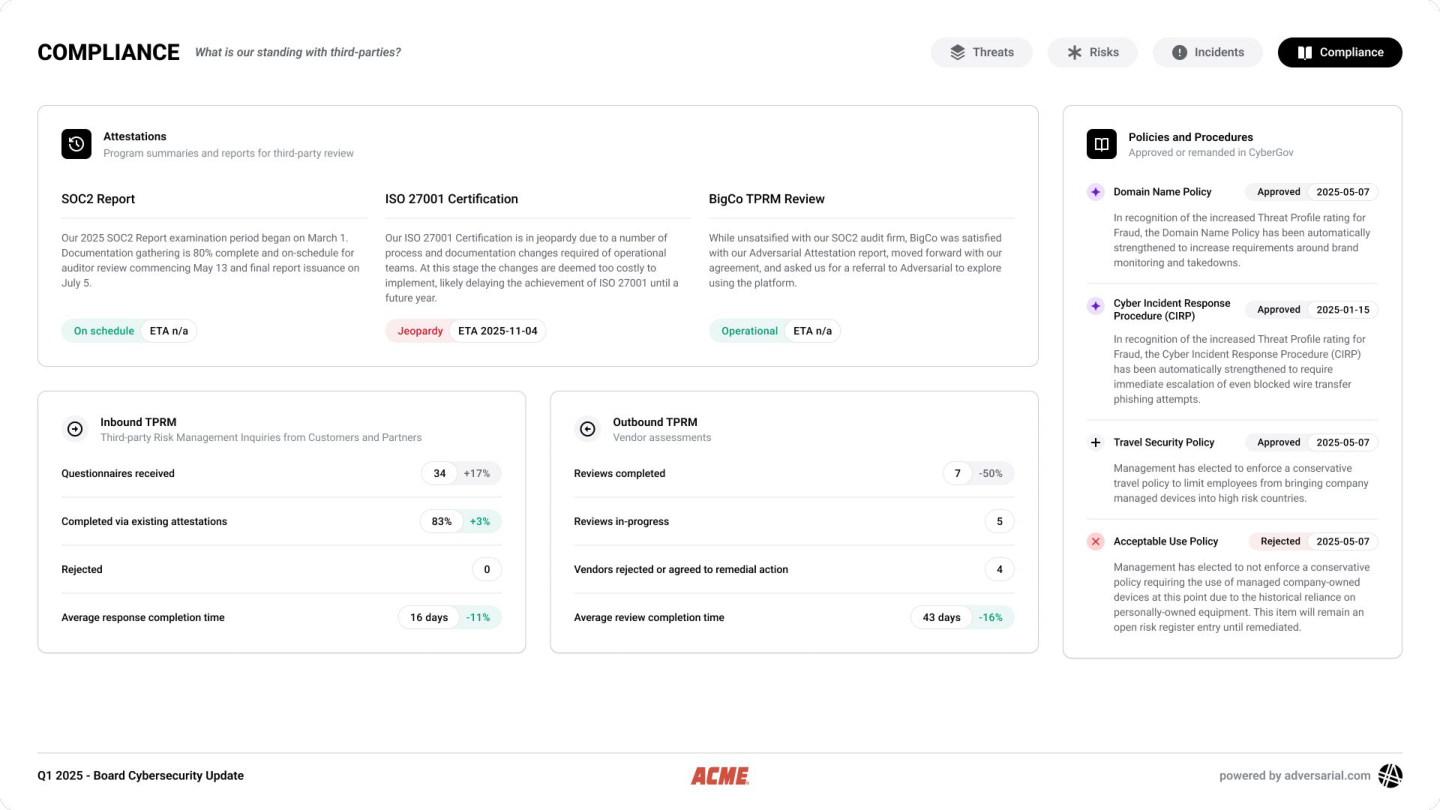
The result is a policy set you can actually read — one that satisfies framework and compliance expectations while staying realistic enough to underpin your security-awareness training. Layer in organizational supplements for the company-specific language you can't live without, and every change is summarized for governance approval, with actual and previewed workforce-compliance trends attached.
Board reports that write themselves.
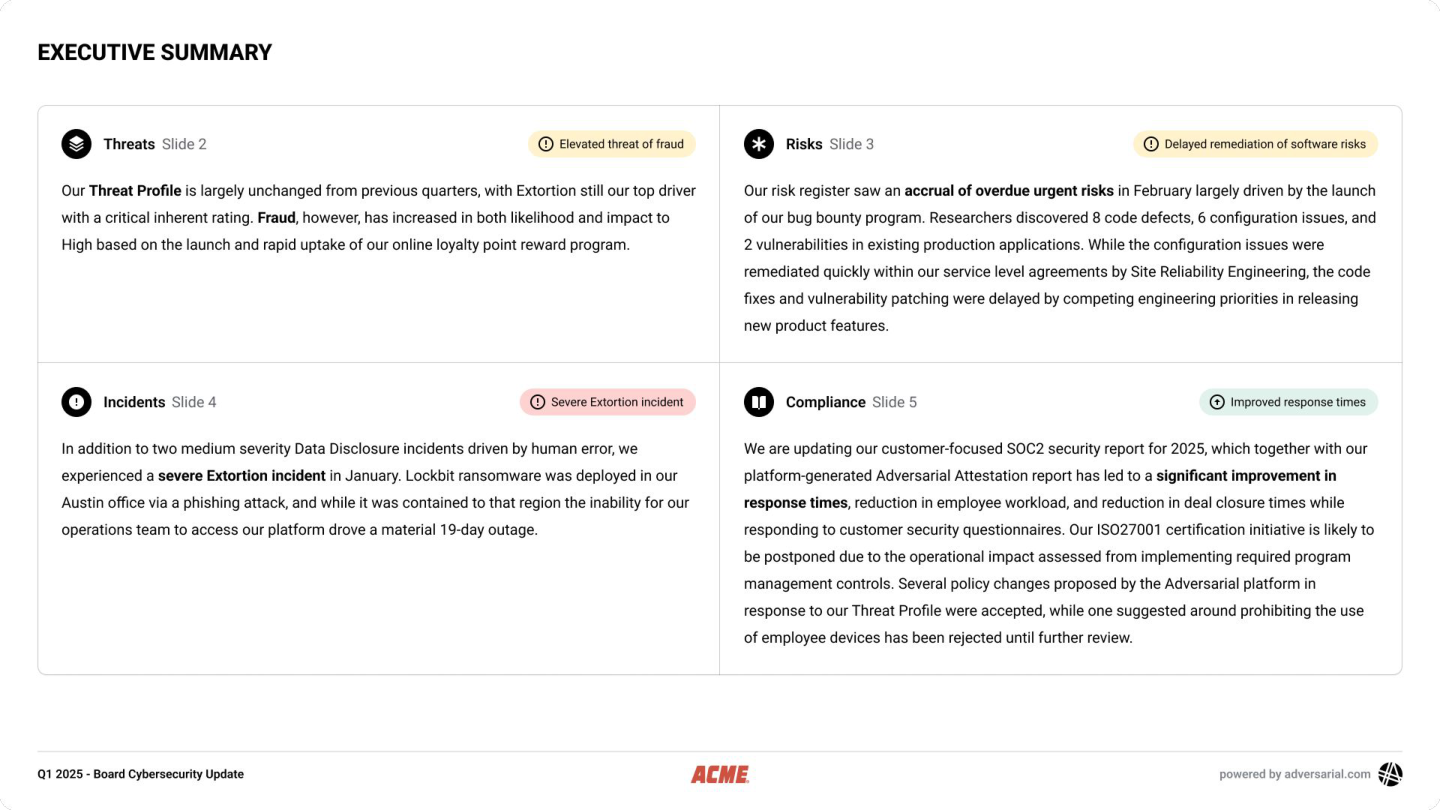
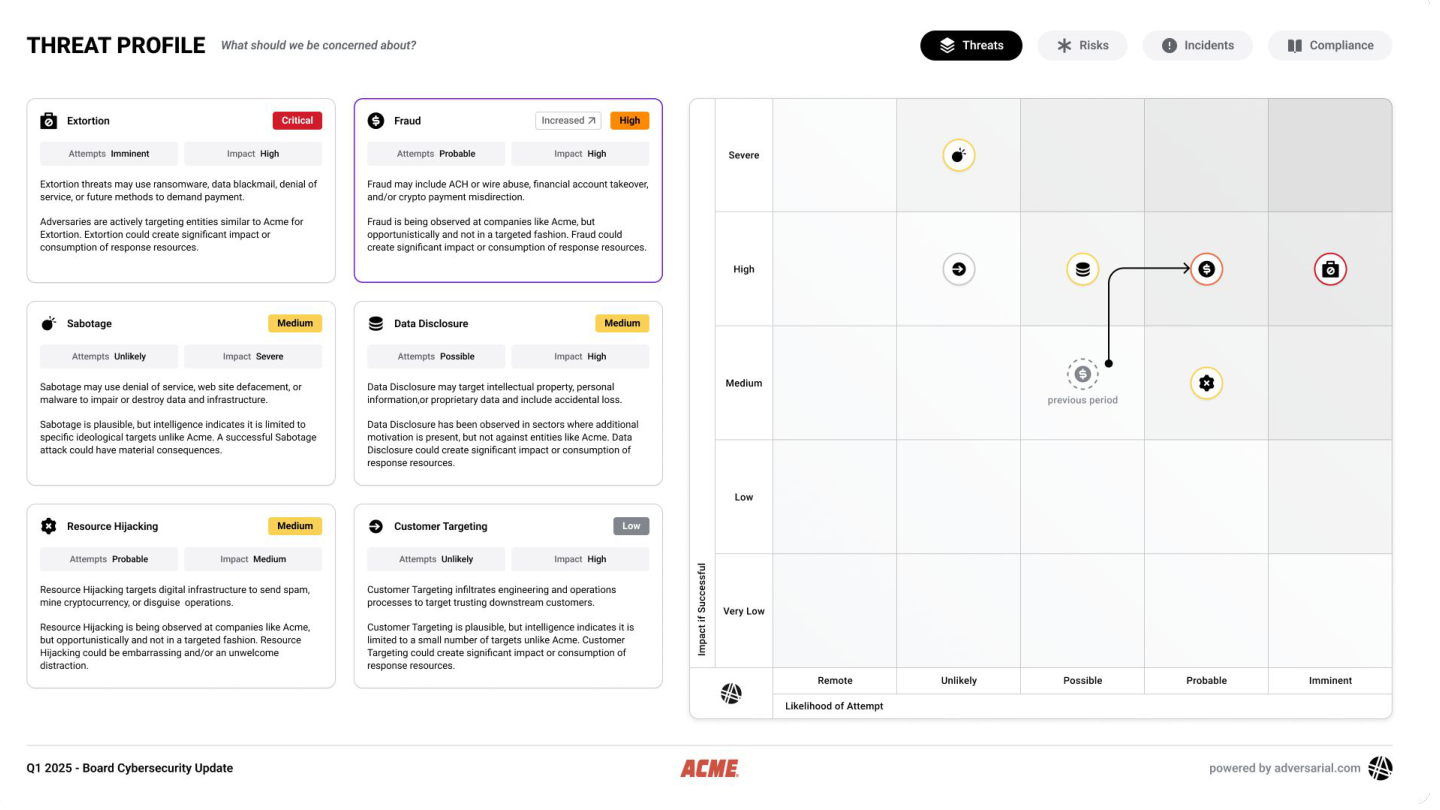
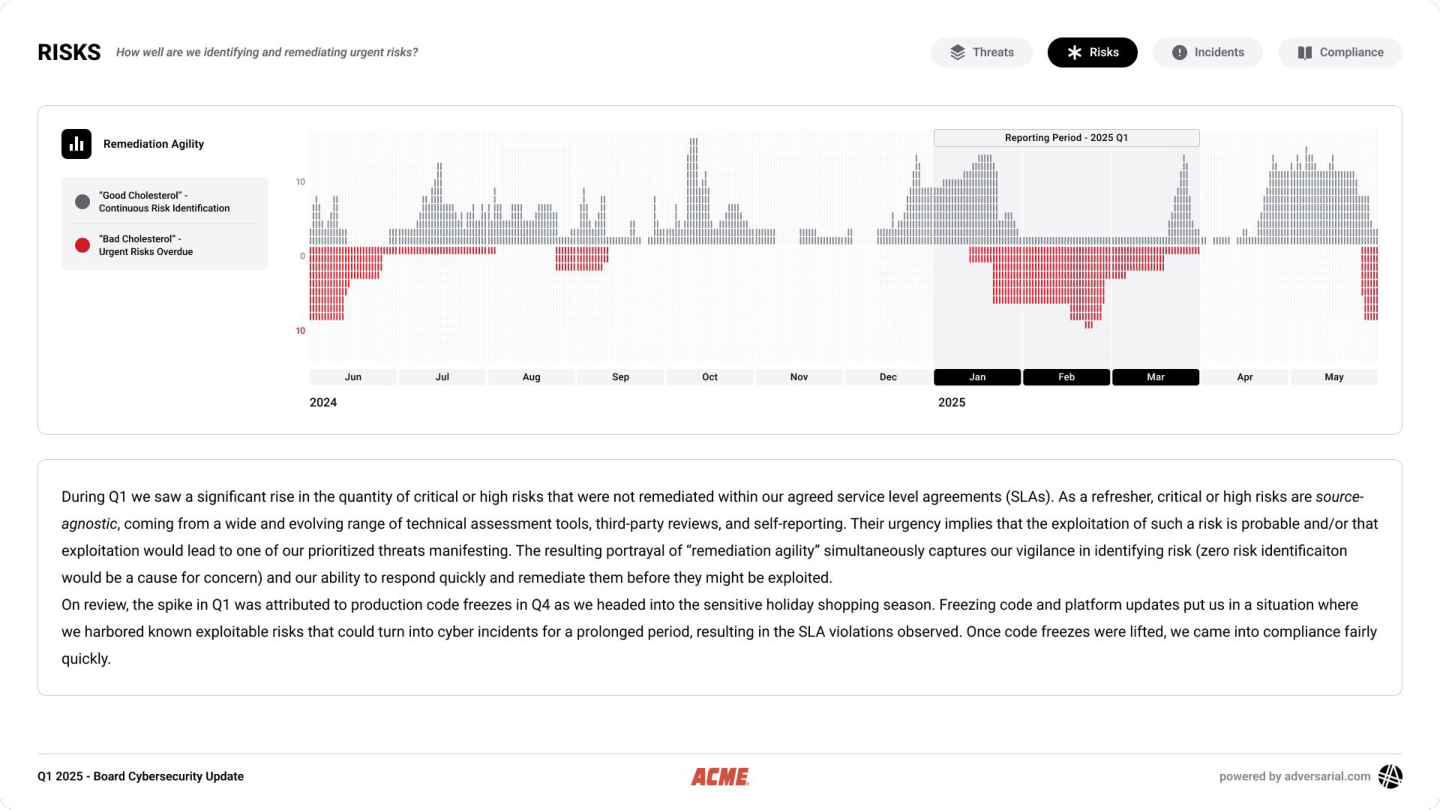
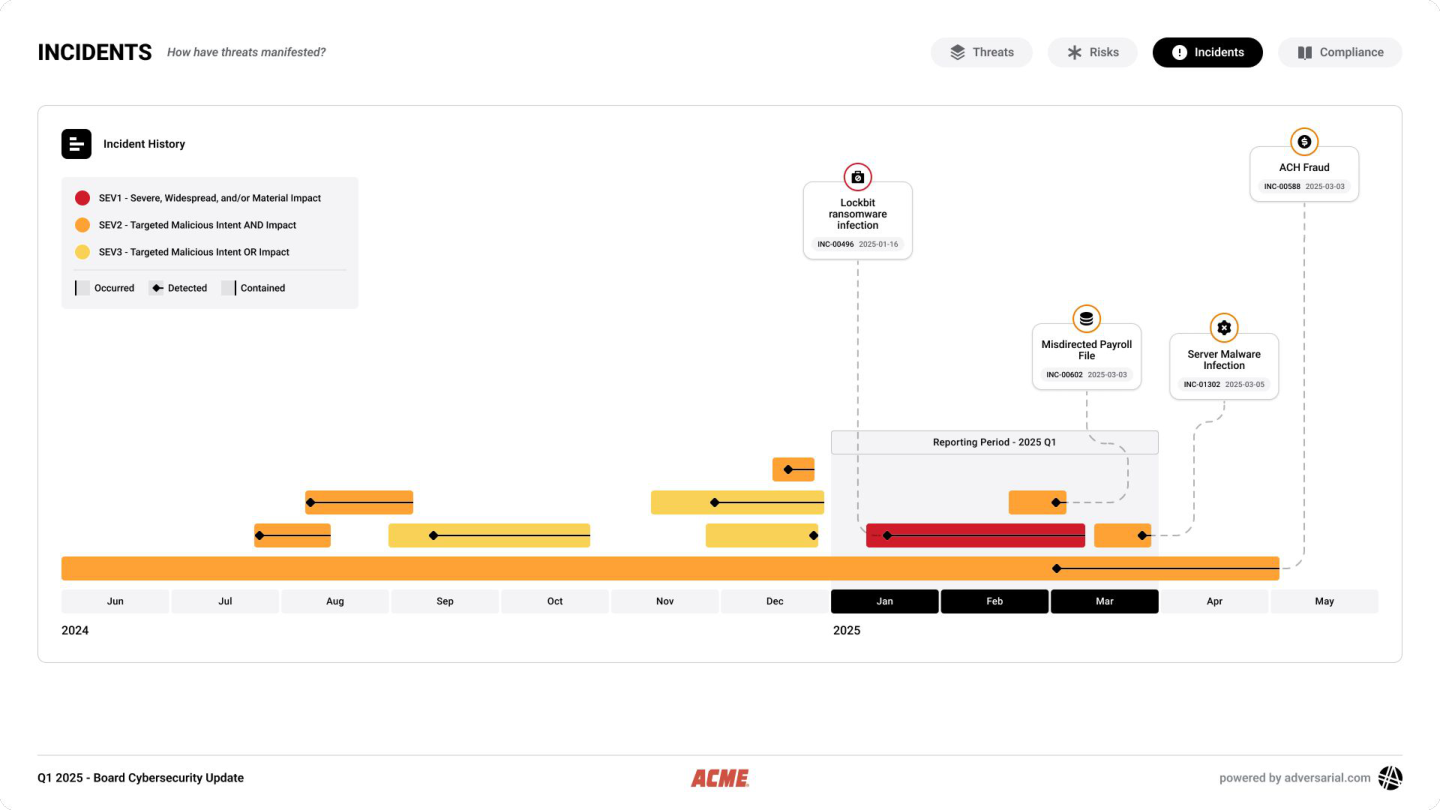
Most cyber governance decks get assembled by hand in the two weeks before the meeting — vocabulary shifts, tools change, numbers change source, and the narrative is skewed toward the most recent firefighting. Add an internal senior leadership committee two weeks before the Board meeting and governance turns into a monthlong season. Adversarial decks are generated continuously from the same risk register and incident record that runs the program. Same structure quarter to quarter, same threat-profile visualization persisting alongside it, hot-risk tables ready for the pre-board SLT meeting.
The result: a clear, consistent cybersecurity story that doesn't depend on specific tools - comprehensible to a non-technical board, defensible under regulator scrutiny.
Tactical instructions, not binders.
RAMP and CIRP aren't whitepapers — they're the procedures the platform actually runs. Every risk is scored by RAMP. Every incident is classified and escalated by CIRP. And your Corporate Information Security Policy (CISP) sets the rules the whole program holds people to. The procedure is the program. The audit trail is the record of every decision it has ever made, alongside the exact prompts and supplements that were in effect at the time.
It's more auditable evidence of program operation than any binder ever produced, because binders don't actually run anything - they just describe vague intentions.
Govern the AI you trust with consequential decisions.
Change control evolved to contain human error in system configuration and software deployment. And yet most organizations are letting employees — and in some cases third parties — turn the knobs on the AI prompts and logic driving consequential risk and incident decisions. Without governance, a high-performance scoring engine can be quietly rendered impotent.
Adversarial has prompt governance built into the core. The procedures are codified, delivered through the platform, and minted as a copy for every customer as their evidenced approach to risk and incident management. As the threat landscape moves, Adversarial issues transparent prompt supplements — visible to the customer, disableable, regression-testable against historical decisions, and accepted on the customer's own timeline. Customers can layer org-specific supplements for their own naming conventions, priorities, and quirks. Changes sweep into governance meetings with summaries ready for approval. Every decision the engine has ever made is on the record, alongside the prompts and supplements in effect at the time.
Read the full AI Prompt Governance brief