
Solution

Board Reporting

On-demand, in real time. Not two-and-a-half months late.

Board reports get assembled by hand in the two weeks before each meeting, then defended as if they were rigorous. The problem isn't the deck — it's that no tool can do board reporting in a vacuum without the underlying tactical risk and incident data. Both leading indicators (risks) and lagging indicators (incidents) are required, and at most firms GRC and SecOps don't talk to each other until deck-prep time. Adversarial is unified for exactly that reason.

Q1 2025 Board Cybersecurity Update1 / 4
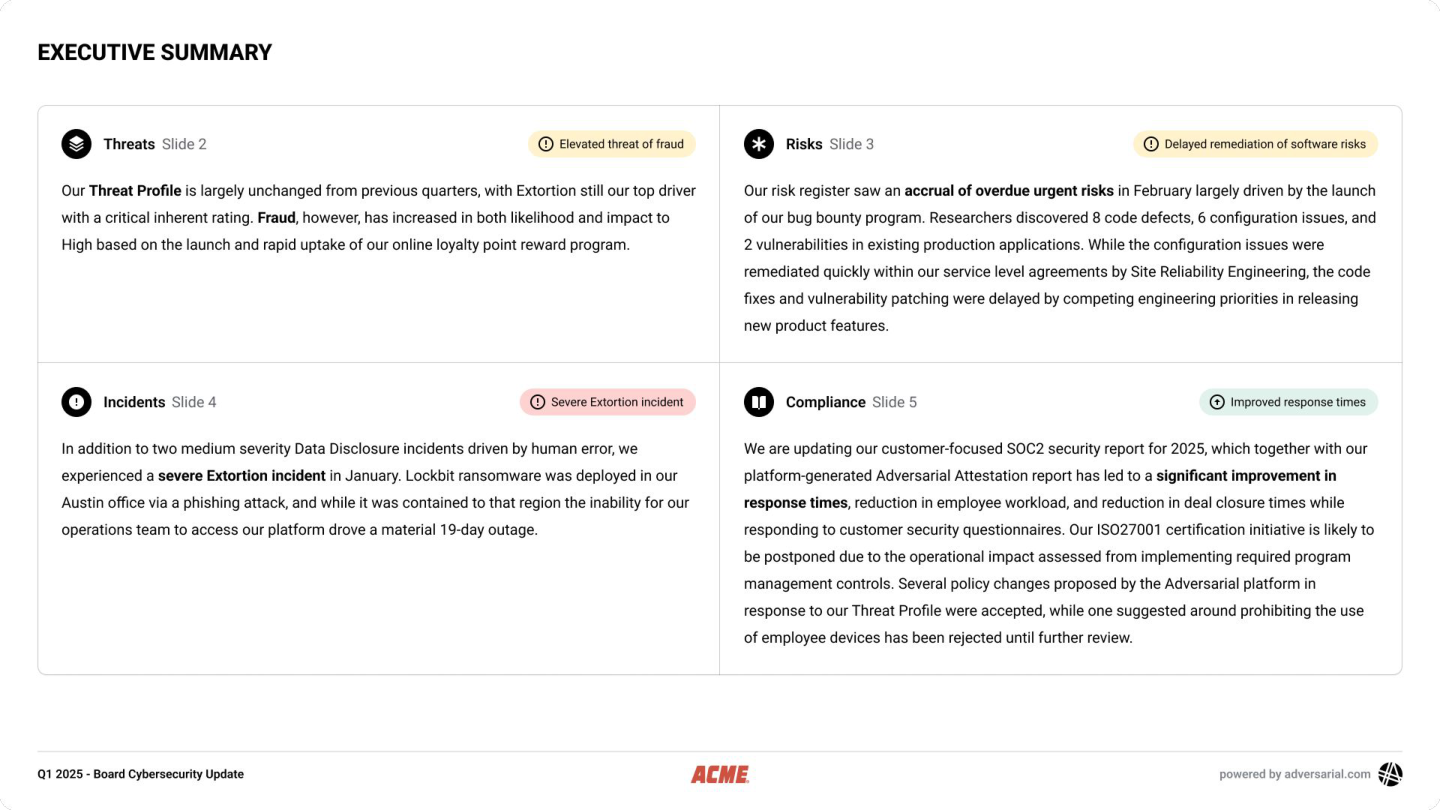
Executive Summary — Threats, Risks, Incidents, and Compliance quadrants with status callouts
Executive SummaryThreats, risks, incidents and compliance on one page, each drawing actionable insights from live underlying data.
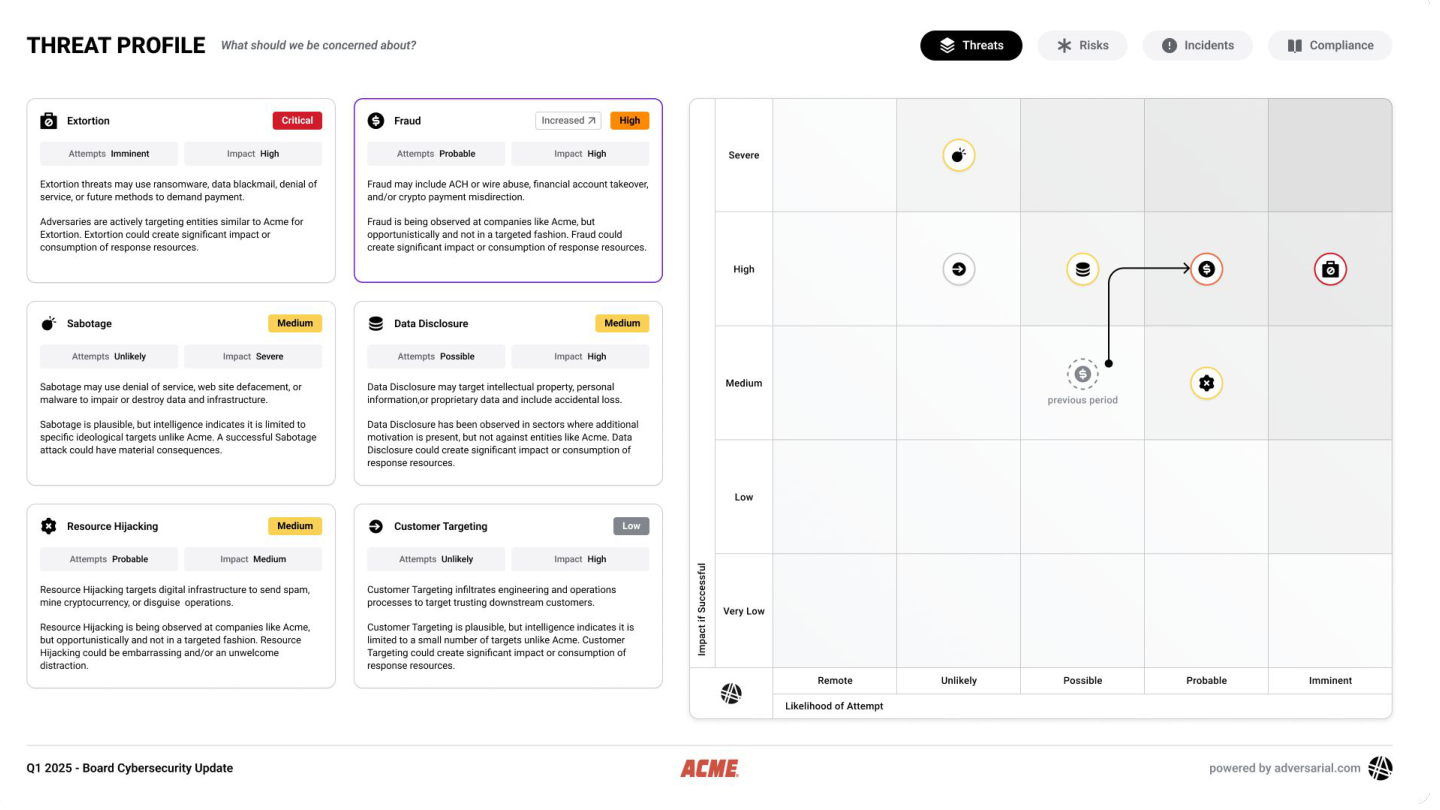
Threat Profile — six Threat Objectives with severity ratings and a likelihood / impact matrix
Threat ProfileYour cyber mission in terms of major, longstanding threats, rated on the likelihood / impact matrix for governance approval or challenge.
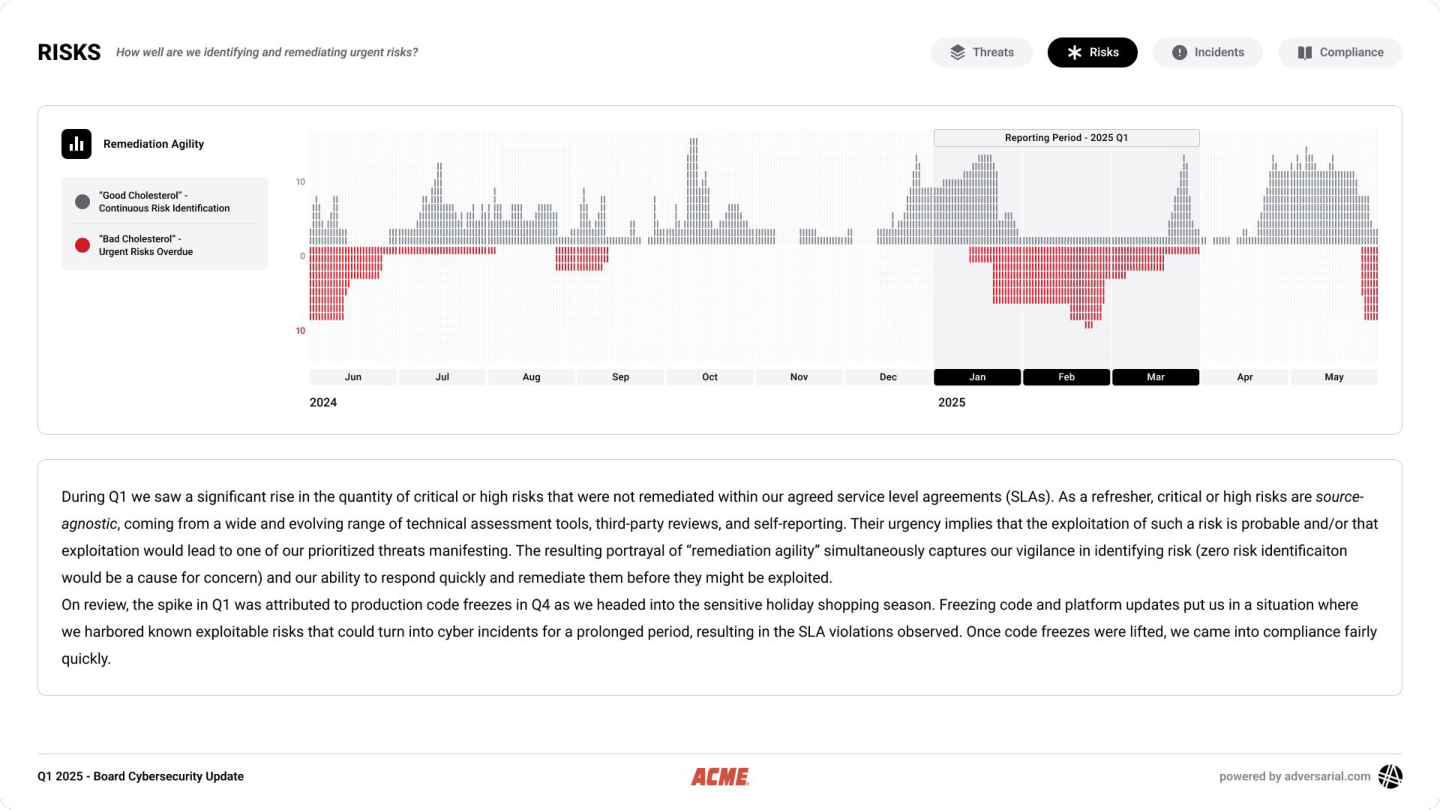
Risks — remediation-agility chart tracking urgent risks identified vs overdue across the reporting period
RisksRemediation agility: urgent risks identified against those going overdue, across the reporting period.
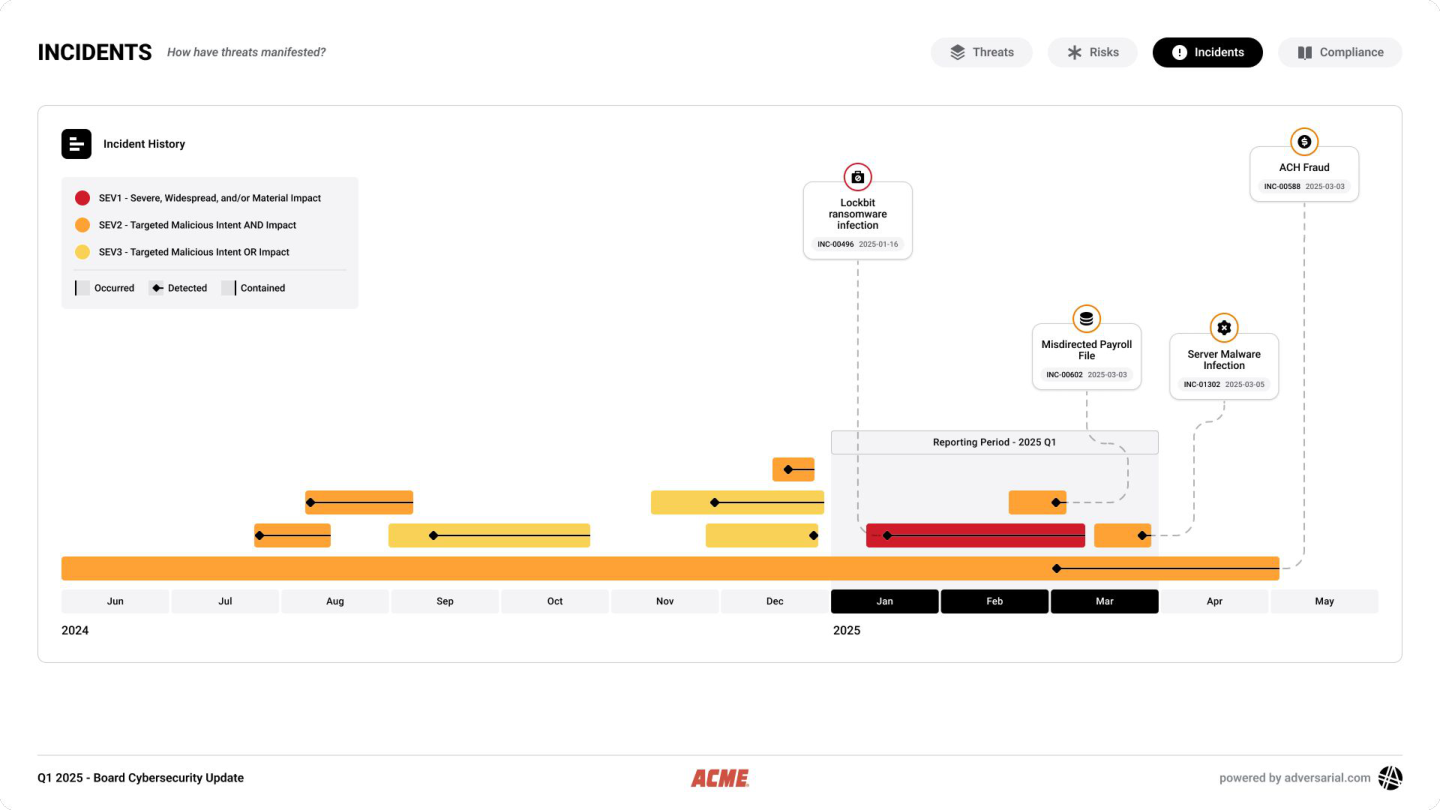
Incidents — incident-history timeline with SEV-coded events plotted occurred / detected / contained
IncidentsIncidents above your defined, consistent reporting threshold on one timeline — occurred, detected, contained — coded by consistent severity definitions.

Swipe for the next slide · turn your phone for a bigger view

How Adversarial delivers Board Reporting

Consistent Quarter to Quarter

Harmonized vocabulary, persistent threat-profile visualizations, and a deck structure that stays stable even as the underlying tools change.

Hot-Risk Tables for CyberGov

Appendix tables come preloaded with the risk and incident detail behind each chart, so when someone asks what is driving a red area, you answer with specifics.

On-Demand, Live

No more closing the books and waiting 75 days. Generate the deck the day before — or the morning of — and the numbers are still current.

Inside the CyberGov Charter: Membership

A deck is only as credible as the governance body receiving it. The charter that seats that body is generated and maintained in the same system as the data in the deck.

CHTRGovernance6 sections

2 Membership

Members shall be “technology literate” in addition to their specific area of expertise and be able to understand fundamental risk management metrics and reports.

CyberGov is composed of voting Members and non-voting Observers (the latter including presenters and subject-matter experts invited as needed), including but not limited to those below.

Members

RoleName
Head of Information Security (Chair)Jane Doe
PresidentMorgan Reyes
Chief Financial Officer (CFO)Priya Rao
General Counsel (GC)Tommy Grant
Chief Technology Officer (CTO)Alex Mendez
Chief Operating Officer (COO)Sam Patel
Head of Human Resources (HR)Riley Chen
Head of ComplianceDana Kim
Data Protection Officer (DPO)Lin Park
Head of IT/CIOChris Vega
Head of Enterprise RiskJordan Ellis
Chief Medical Officer (CMO)

Observers

RoleName
Lead Security Engineer (Presenter)Sam Okafor
Internal AuditDana Whitfield
External CounselRidgeline LLP
Cyber Insurance BrokerHalstead Risk

The whole thing is Adversarial.

Board Reporting is how analysts in this category will recognize the platform — but underneath it is one deterministic system of record covering threats, risks, incidents, and compliance.